
Project Overview
Client Industry: Broad spectrum engineering / automotive testing
Company Size: Small
Client Location: UK (Headquarters in Europe)
The client needed to obtain a UK Conformity Assessment (UKCA) for a sophisticated piece of test equipment designed to support a larger automotive battery pack testing system.
As the test equipment was bespoke, it needed to be uniquely certified to bring this product to market in the UK. This required a declaration of conformance and the equipment to carry a UKCA mark, confirming compliance with relevant UK regulations.
The key challenge was determining which regulations and standards applied to this specific piece of equipment, and then demonstrating that the product met these requirements.
The UKCA logo
What were the safety risks/challenges?
UKCA marking is required for applicable products placed on the UK market. Any electrical equipment must demonstrate compliance with relevant regulations and safety standards before it can legally be supplied to the market.
This project involved several technical challenges:
Challenge 1: Identifying the relevant regulations.
The first step was determining which UK regulations applied to the product. We conducted a detailed regulatory review and carried out both a Hazard Analysis and Risk Assessment (HARA) plus a broader risk assessment to identify potential hazards and compliance requirements.
Challenge 2: Identifying the appropriate standards
Once the relevant regulations had been identified, the next challenge was determining which engineering standards supported those regulations. These standards provide the requirements needed to demonstrate compliance.
Challenge 3: Demonstrating compliance
After identifying the relevant standards, evidence was required to demonstrate compliance. To support this process, 3SK developed verification checklists outlining the actions required to prove the product met the applicable standards.
Were there compliance or regulatory concerns?
The client had already implemented many good engineering practices, but required guidance to ensure their approach fully aligned with UK regulations. One area requiring attention was electromagnetic compatibility (EMC), where regulatory requirements rely on what is considered ‘good engineering practice’.
3SK provided a clear roadmap, guiding the client through the necessary steps while the client implemented the technical work internally. Unlike some certification schemes, UKCA compliance does not require submission to an external authority. However, organisations must maintain a technical file containing evidence of compliance, which must be retained for at least 10 years and made available in the event of an audit.
Once the requirements were met and evidence documented, the product could be labelled with the UKCA mark.
The Solution
Approach
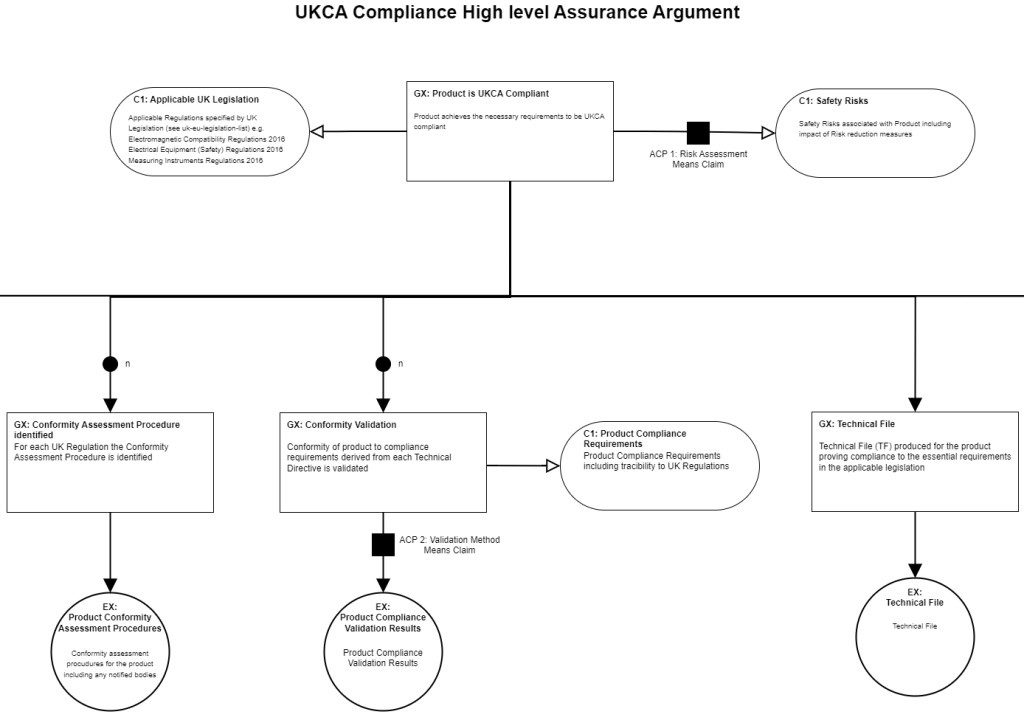
3SK worked with the client to define a clear compliance roadmap, outlining the steps required to achieve UKCA compliance. As part of this approach, the team developed an assurance case, which structured the evidence and arguments demonstrating that the system met the required safety and regulatory standards. (I want an image of the assurance case to be included on the website to illustrate this methodology if possible?)
The project was delivered over approximately four months, providing the client with both guidance and a structured pathway to compliance.
Consulting
3SK supported the development of the Technical File, a key document required for UKCA compliance.
This file included:
- user documentation
- evidence of compliance with relevant regulations and standards
- supporting analysis and verification material
3SK advised the client on the content, structure, and documentation required to ensure the Technical File would meet regulatory expectations.
One notable finding during the analysis was the presence of high current, low voltage electrical systems, which introduced potential electrocution risks. This required a deeper evaluation of the electrical hazards, including consideration of the physiological effects of electric current on the human body, to ensure the risks were properly understood and mitigated.
Training
3SK provided guidance and knowledge transfer throughout the project, helping the client understand both the regulatory requirements and the reasoning behind them. This ensured the client not only achieved compliance for this product, but also developed the internal capability to approach similar compliance challenges in the future.
Systems / Methods / Tools
The project utilised several structured engineering methods including:
- Hazard Analysis and Risk Assessment (HARA)
- Engineering risk assessments
- Assurance case development
- Compliance verification checklists
- Technical File development for regulatory compliance
Collaboration
The project was delivered through close collaboration between 3SK and the client’s engineering team. 3SK defined the compliance roadmap and provided expert guidance, while the client implemented the necessary engineering and documentation activities. This collaborative approach ensured the solution aligned closely with the client’s product design and engineering processes.
Results
Risk Reduction
The client successfully implemented the relevant regulations and standards for inclusion in their Technical File, enabling the product to achieve UKCA compliance.
Efficiency Gains
Throughout the project, the client gained a clear understanding of the UKCA compliance process, enabling them to apply the same approach to future engineering products more efficiently.
Compliance Reached
The project successfully demonstrated compliance with UKCA regulatory requirements, allowing the product to be legally supplied to the UK market.
Feedback
The success of the project led to further opportunities for collaboration. The client subsequently referred 3SK to one of their own customers, and invited the team to present at their user conference, highlighting their satisfaction with the support provided.
Financial Impact
3SK’s support helped the client deliver the product within the required timeline, enabling them to meet key project deadlines for their customer.
While the client had already implemented many strong engineering practices, the project helped deepen their understanding of the reasoning behind certain corporate and regulatory standards.
This clarity enabled their team to better understand not just what was required, but why those requirements existed, strengthening their internal engineering approach.
Summary
Through this collaboration, our client gained a clear understanding of the regulatory compliance journey required to bring their product to market. 3SK’s support enabled them to achieve UKCA compliance in a structured, timely manner, while also building the internal knowledge needed to support future product development.
If your organisation is developing safety-critical technology and needs clarity, structure, and confidence in your path to launch, 3SK can help.
Why Work With 3SK?
- Deep expertise in complex, software-intensive engineering
- Proven track record delivering safety-critical programmes
- Bespoke solutions tailored to each client’s development environment
- Ongoing support and knowledge transfer to sustain compliance long term
Read more of our case studies here